
As a two-part piece that typically requires at least six hours of stage time, Tony Kushner’s Angels in America saga asks a lot from its audiences—and its critics. For instance, in my six years of reviewing plays, this is the first time that covering a single theatrical event has demanded that I make two separate trips to the theatre.
Starting with its refusal to fit into a single evening, Angels in America fascinates me as an example of a piece that follows few of the traditional “rules” of theatrical storytelling, something I began to explore in my review of Part 1: Millennium Approaches.
Without ever losing sight of the captivating human story at its heart, Part 2: Perestroika pushes the formal boundaries even further with more fourth wall breaks, wilder fantasy sequences, and huge metaphysical leaps with ontologically unsettling implications.
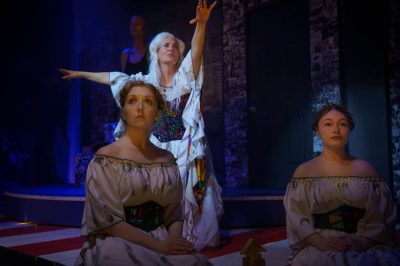
In Theater West End’s remarkable production, these thematic elements are echoed in the bold staging decisions of co-directors Bryan Jager and Hunter Rogers. A sense of immersion is created by their willingness to use the entire theatre space rather than limiting the action to the stage. Actors enter from all around the room to wander through the audience area and play scenes in the aisles and in other crevices, like behind a railing at the back of the house.
The lighting design (Derek Critzer) and sound (also by Jager) ensure that the performers are always audible and visible in the most unconventional of locations, while enhancing the atmosphere with striking moments.
At the performance I saw, there was one technical wrinkle with the use of the production’s turntable, which apparently lost the capacity to move towards the end of Act 2, slightly affecting the timing of intermission. In the middle of a dramatic moment, an actor yelled hold, and the performers onstage exited in a way that looked a little unusual but overall felt like part of the show.
It’s only towards the end of intermission when a tech announces they are holding for a few extra minutes so the actors can plan for their scene changes to account for the lack of a working turntable that I put the pieces together.
But this is beauty of live theater.
For an on the fly adjustment, Act 3 felt surprisingly seamless by the change of plans. If anything, the wrinkle actually may have enhanced the effect of a later scene where it is supposed to look like something has gone wrong technically, but it’s actually a specific interpretative choice — one of the production’s most interesting.
In this scene, Heaven is represented as a chaotic backstage area, with some actors costumed to look like techies and others studying scripts. In this conception, divine authority eerily collapses into theatrical machinery, taking the play’s blurring of illusion and reality one step further.
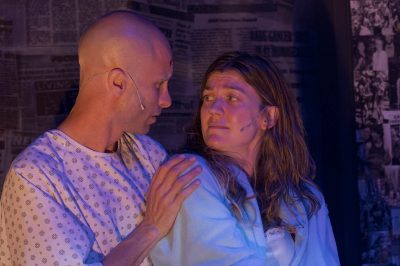
Having praised the entire cast for their part 1 performances, I’m happy to report that they maintain their firm grasp on their characters in part 2. Each role is so meaty and the dynamics between the characters are so charged and complex that it’s a miracle they all pull everything off so well.
Maria Tew’s costume design remains on point, helping transform the ensemble into everything from the techy angels to characters in a Mormon diorama. Those responsible for managing makeup also did a particularly great job at creating Prior’s lesions.
There was no question in my mind about how well-realized this production is, which means my only remaining questions have to do with the script itself and whether the story is still worth telling today.
Some of its specifics may not be as relevant as they were, but the broader implications remain chillingly timely. You don’t have to look far to make connections between the hypocrisy and sexual secrecy of Roy Cohn and things currently in the headline. In watching the wealthy Cohn horde AZT as the AIDS epidemic raged, I couldn’t help but think of the inequality raging in today’s healthcare system.
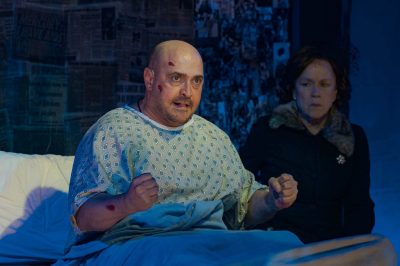
And, all political implications aside, the dramatic power of this wonderfully unwieldy script remains intact, despite the fact that it occasionally seems to get lost in its overlarge ambitions. If you already caught Part 1, you definitely won’t want to miss seeing this epic through to its surprisingly hopeful conclusion. And I’ve got great news for you if you regret missing it— another performance has been added on March 7th, so you can still see the whole Angels saga in its entirety.
Considering how few theatres have the resources and ambition to commit to an undertaking as massive as Angels, it may be your last chance for a while. And, even if that weren’t the case, it’s hard to imagine a production that handles all the ups, downs, and intensity as well as Theater West End’s version. You have only until this March 8th to see Part 2: Perestroika for yourself!
Showtimes and Ticket Info:
Available starting at $28 here for performances at Theater West End (115 West 1st Street, Sanford, Florida 32771)
Thursday, February 26, 7:30 pm
Friday, February 27th, 7:30 pm
Saturday, February 28th, 7:30 pm
Sunday, March 1st, 2:00 pm
Monday, March 2nd, 7:30 pm
Thursday, March 5th, 7:30 pm
Friday, March 6th, 7:30 pm
Saturday March 7th, 7:30 pm (additional performance of Part 1: Millennium Approaches at 2:00 pm)
Sunday, March 8th, 2:00 pm
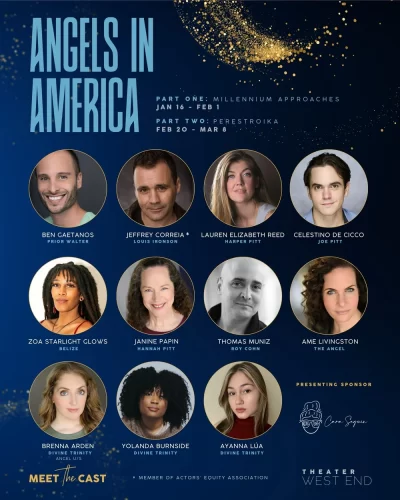
Full Crew Credits:
CO-DIRECTOR – HUNTER ROGERS