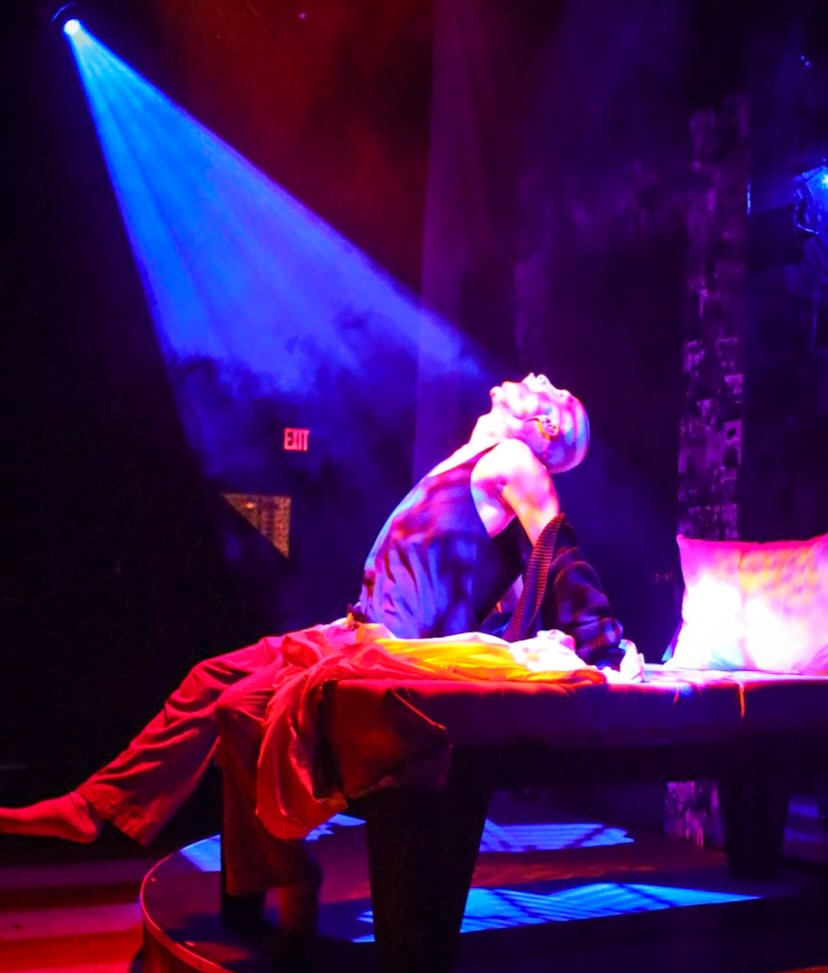

Adventurous Orlando theatregoers are in for a treat with Theater West End’s current production of Angels in America: Millennium Approaches. First produced in 1991, this influential play by Tony Kushner is only the first of Angels In America’s two parts—and Theater West End has ambitiously chosen to take on both.
It’s hard to overstate the massive scope of this undertaking, starting with the fact that each Angels play is over 3 hours long. Then, there’s the epic scope of the saga’s story, which is in its most basic sense about the experiences of a handful of main characters in mid-1980s New York. Subtitled “A Gay Fantasia on National Themes,” Angels is also centrally concerned with the way those characters are affected by the era’s raging epidemic of HIV, which disproportionately affected the gay community.
But don’t make the mistake of writing this one off as being “about” AIDS or homosexuality when playwright Kushner was clearly concerned with so much more. Politics and religion are two more themes that stand out, but it isn’t only the play’s incisive treatment of these divisive topics that makes Angels so unique and uniquely challenging.
There’s also Kushner’s bold formal inventiveness, which allows his vision to transcend the limits of his characters’ “reality” by theatricalizing their inner lives. For instance, we learn much about pill-popping housewife Harper’s bleak inner landscape through surreal scenes that take us into her Xanax-fueled fantasies. Other characters are visited by ghosts and otherworldly figures, like the mysterious “angel” referenced in the play’s title.
In this production, these loopier excursions served to add texture and whimsy while still feeling grounded in the story’s naturalistic spine. They also went a long way toward keeping the story from growing stagnant, something that I feared was inevitable when I saw that the show was scheduled to run a full three and half hours. Especially since I already knew the plot’s basic trajectory, I expected to be counting the minutes until my next I-phone check. Instead, Kushner’s compelling characters and non-stop narrative curveballs quickly had me 100% engaged.
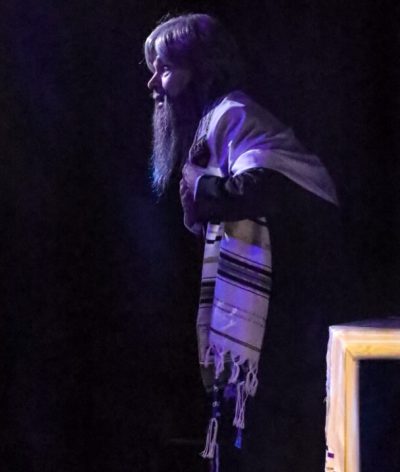
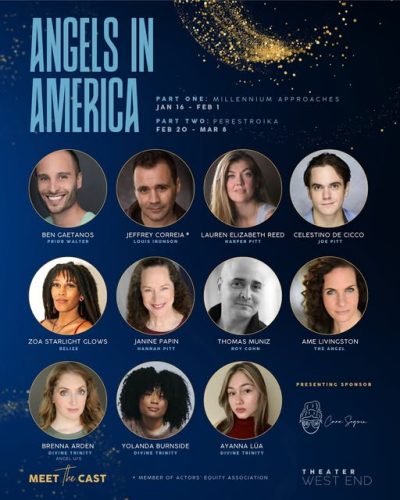
Through doubling called for in the script, a main group of eight principal actors (Thomas Muniz, Lauren Elizabeth Reed, Celestino De Cicco, Zoa Starlight Glows, Jeffrey Correia, Ben Gaetanos, Janine Papin, and Ame Livingston) play at least twice as many characters. That they can pull this off pretty convincingly is a testament not only to their skill but to that of costume designer Maria Tew and wig designers Natalie Rodriguez and Ryan Moore (credited for prior wig design).
Between the fake mustaches and heavy accents, these transformations were at times so convincing that I genuinely found it hard to figure out which actor was under what disguise. Even for Brenna Arden and Ayanna Lúa- two additional actors who spend most of the show as background players—there was no shortage of warp-speed quick changes, their looks and identities shifting nearly every scene.
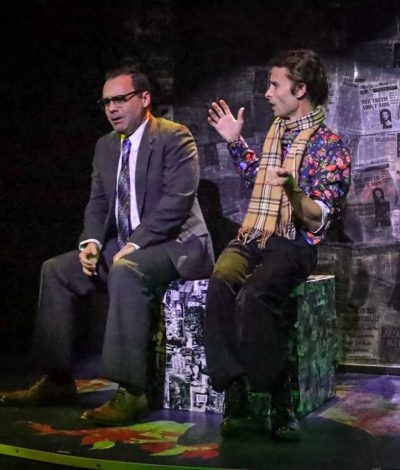
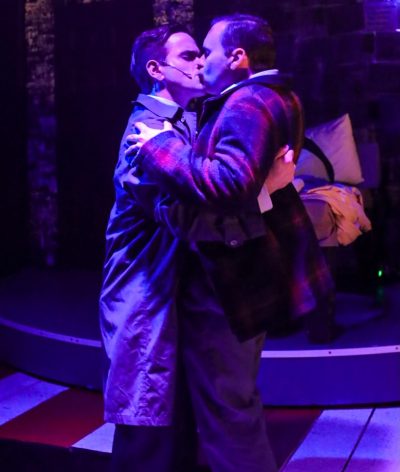
Performances were excellent across the board, with Janine Papin and Ame Livingston given the chance to create some particularly strong characters in their respective tracks.As corrupt politician Roy Cohn, Thomas Muniz brings the house down with broad comedy in early scenes and brings chilling anger to later ones. I was also particularly impressed by Lauren Elizabeth Reed’s vulnerable and intense performance as housewife Harper and Celestino De Cicco’s confident portrayal of Joe, her closeted husband.
Zoa Starlight Glows brings a beautifully nurturing energy to her role as caretaker Belize, and Jeffrey Correia is quite funny and surprisingly sympathetic as his conflicted character Louis.
But if I had to narrow it down to one standout, it would probably be Ben Gaetanos, who gives a dynamic, layered performance as his character Prior Walter struggles to make sense of a terrifying prognosis.
Co-directors Gabriel Garica and Hunter Rogers help create great moments of synergy and palpable chemistry between the show’s various pairs of scene partners. Momentum stays high and the pace rarely faltered, and the few “slow” points I did notice seemed to have more to do with the play’s writing than its performance.
The show’s substantial technical challenges are also handled creatively and gracefully by Theater West End’s team. To manage the play’s frequent transitions, the set frequently shifts through use of a turntable, with scenic design by Derek Critzer and Gabriel Garcia effectively using small details to suggest different locations.
Projections designed by Bryan Jager are sometimes incorporated to complete the illusion, and are particularly transporting during one memorable fantasy sequence.
For the most part, I was too wrapped up in the play’s action to pay much mind to Critzer’s lighting design or Jager and Garcia’s sound design, but both became especially striking in key moments that I don’t want to spoil for any prospective audience members.
For adventurous theatregoers, Angels In America: Millenium Approaches is worth seeing for countless reasons. In its own right, it’s an intensely captivating piece; one that’s original, insightful, affecting, and, considering its dark themes, often a lot funnier than you’d expect. It’s also a piece that was considered groundbreaking when it premiered, has had huge influence since, and is widely regarded as one of the greatest plays of the 20th century.
However, before recommending it unreservedly to general audiences, I should probably emphasize, once again, how weird it is. I didn’t find it particularly hard to follow, but all the impressionistic, surreal stuff might be a little much for anyone who prefers more linear storytelling.
Then, there’s the content side of things: it’s a heavy piece that deals heavily with death and dying, and that allows its characters to articulate some pretty unsettling ideas.
You can also expect plenty of sexual references, violent imagery, representations and talk of some pretty gross medical symptoms, and who knows that else I’ve left out.
Discomfort with any of this is a valid reason to consider skipping this one or doing more research.
But, to go back to the pro column:
The script is incredibly smart, full to the brim of quotable quips and clever banter- it will probably make you laugh and definitely make you think. This is an outstanding production that feels true to the spirit of the play and faithfully tells the story, showcasing several of our area’s best performers in the process.
Finally: though it may be a period piece, the period that it explores is a period in which Americans were fiercely divided over politics, religion and sexuality. You can’t say that there isn’t relevance to Kushner’s vision of ordinary people hanging on in an America that appears to be in need of divine intervention… or on the verge of collapse.
“Angels In America: Millenium Approaches” At Theater West End
Remaining Performances
Thu 1/22
Fri 1/23
Sat 1/24
Sun 1/25
Mon 1/26
Thu 1/29
Fri 1/30
Sat 1/31
Sun 2/1