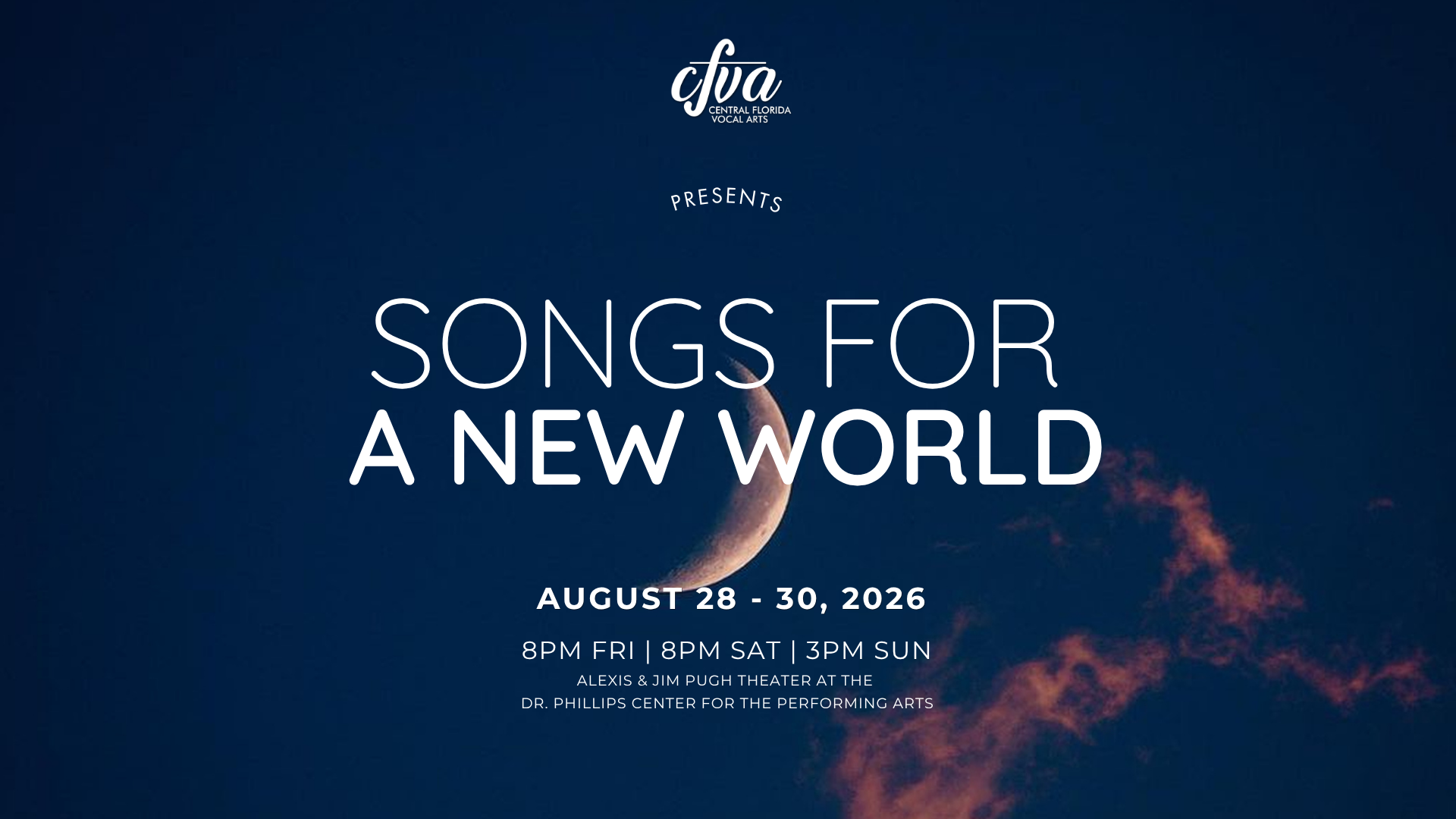

It’s always a bit of a fun experiment to find myself in a position to review the same show as it manifests across different productions. Sometimes, different approaches change my interpretation of a work, and sometimes they do so quite dramatically- but what happened inside my head and heart when I encountered Central Florida Vocal Arts’ stunning production of Songs For A New World this weekend feels, in part, like something a little different.
Yes, there were ways in which the performances, direction, and other elements at play created a sublime artistic experience that ultimately amplified my appreciation for the piece, which I’ll absolutely go into more detail about once I get through this introductory tangent and into, you know, the actual review.
But what I wanted to spend a moment pondering first is something that’s actually a perfect segue into some of the strongest thematic threads that shape this particular song cycle, which, rather than offering a linear plot, is primarily concerned with portraying characters at pivotal “moments of decision,” defining themselves through choices that will shape the rest of their lives.
Not only has my perspective as a critic evolved in profound ways in the five years since I first wrote about Songs For A New World in a completely different theatrical context, but there are things that have changed meaningfully in the larger world around us, and in ways that the respective productions seemed eager to bring my attention to.
In 2021, a Fort Lauderdale company’s version of the piece was actually one of the first shows I reviewed as theatre was springing back to life after a long pandemic-forced hiatus, a real-world context that the production emphasized explicitly in an introductory video sequence. At the time, that context supplied an extra layer of resonance to songs about characters wrestling with loss, struggle, and stagnation—but also one that, against the backdrop of reopening and revitalization, seemed to supercharge the play’s earnest attestations to renewal and hope.
Needless to say, this is a much different sort of time in modern America, and it’s definitively a sort of time in which hope itself feels in very limited supply. Which actually made the way that this production set the scene a particularly striking contrast. In a moving pre-show video, we were introduced to Central Florida Vocal Arts as an organization that does more than just put on theatrical productions. They also offer a variety of educational programming for aspiring Orlando performers of all ages— and it’s this aspect of their mission and work the segment mostly focuses on. First though, we meet a CFVA student named Diego, who, memorably, sings a line from Songs For A New World before describing a family struggle with homelessness that left him and a plethora of relatives living out of an RV.
Which is something that shouldn’t have had to happen, executive director Theresa Smith-Levin later notes.
But, unfortunately, these things are happening. And between this specific example and, well, everything else going on around the country lately, I found my attentions repeatedly drawn to the way in which many of the “thresholds” the characters find themselves at can be boiled down to the difficulty inherent in trying to live one’s truth when one happens to live in a society without safety nets.
Listening to Songs for a New World today, there was something that felt far more more precarious in these portraits of characters who find themselves on mostly figurative but occasionally actual precipices. And there was also something particularly poignant about watching them as they made their leaps of faith or failed to that came with the knowledge of how much they’re risking should they fall.
To start on the more literal side of the equation, in early comedic showpiece One More Step, a spoiled housewife threatens to jump off a balcony as a ploy to recapture her wealthy husband’s attention. And to highlight just how broad the show’s tonal range is with one of the more “figurative” examples, there’s the tear-jerking pathos of 11 o’ clock number Flying Home, which finds a soldier who has risked everything for his country making a fated transition between this mortal realm and whatever awaits him on the other side.
In between, we meet characters who contemplate how much they are willing to sacrifice for love, how much they are willing to sacrifice for justice, and how much they are willing to sacrifice for even a chance at material “success.”
In understated ballad Stars and The Moon, one character viscerally regrets choosing a partner who could offer her financial security over other romantic prospects whose worth could, instead, be measured in “fire and passion.” And in flashier uptempo number Steam Train, a character’s insistence that he has what it takes to become a basketball star mostly reads as playful and aspirational…until a gradual revelation of details about his upbringing suggests that his compulsive forward motion is less a matter of believing he is exceptional than a desperate attempt to beat the odds.
In playing that character among others in a track designated as “Man 1”, actor Armon Flukers clearly has the charisma needed to sell us on this act one closer with his suave certainty, which magnifies the impact of the later more vulnerable moments.
Earlier on, director McKenzie Pollock’s dynamic staging of duet The River Won’t Flow allows Flukers’ Man 1 to share beers with Sean McKinley’s “Man 2” as each man voices frustrations about a bottleneck in the system that leaves both wondering if their hard work might ever be sufficient to ensure them equal access to opportunity.
The rich, solo-heavy score gives each of the four ensemble members plenty of time in the spotlight amidst opportunities to contribute background vocals or harmonies, as Emily Minch’s Woman 1 and Sabria Sego’s Woman 2 did in the aforementioned number in between respective star turns.
Minch, for instance, is a powerhouse vocalist who gets several chances to showcase her skills as she takes center stage in songs like Christmas Lullaby and I’m Not Afraid Of Anything. This track eventually positions her as the romantic counterpart of McKinley’s Man 2, with whom she feels generally well-matched in presence and in chemistry, an impression bolstered by intimate blocking that helps to solidify the impression that their characters’ relationship solidifies over the course of the play’s otherwise nebulous arc.
McKinley, too, gets plenty of stage time to himself as his character guards against vulnerability in an assured She Cries and then, in stunning Act 2 opener The World Was Dancing gives a stellar performance in a song that dramatizes the way precarious circumstances and generational trauma can undermine even the most earnest attempts at starting anew.
And though Sego, a recent high school graduate, seemed a bit obviously miscast in a maternal-figure type role that usually calls for a middle-aged actress, she at times seemed to lack some of the gravitas the part theoretically called for but otherwise proved an impressively engaging performer. Her confidence in her comedic chops seemed to improve over the course of the performance, but she is perhaps at her best when given the opportunity to express a more earnest sentiment while embodying, for instance, a 1775 flagmaker sublimating her sorrows into sewing stars.
Overall, Pollack makes the most of the material by allowing the characters to engage with one another wherever possible, turning a relatively basic set up consisting mostly of platforms and curtains into a surprisingly versatile playing space. Mostly, the actors are up to the considerable vocal challenges posed by the demanding material, though some of the otherwise good singers seemed considerably less comfortable when forced by the score into territory that seemed to surpass their usual limits.
Fluker, for instance, seemed to be struggling to sustain an extended high-octave stretch during Steam Train— but when later songs allowed him instead to reach into the same register with somewhat more control, the effect was so impressive as to feel almost transcendent, especially when paired with his character’s devastating circumstances in songs like Flying Home and King of the World, in which he plays a character facing seemingly unjust imprisonment.
Because of its unusual structure, it’s also worth noting that Songs for A New World is the kind of show that’s remarkably accessible to audiences of all backgrounds without even necessarily requiring much of an attention span— since every song is basically a new story, you’re basically free to zone in and out as you please and still get the gist.
But the lack of conventional narrative cohesion means it’s also a show that doesn’t offer easy answers— or, really, much of any answers, since we don’t stick with any individual character or plotline long enough to see things resolve. Instead, the show’s cosmology seems to propose a growth that’s more like an evolution across lifetimes— and, importantly, every step along the way seems to bring the characters closer to one another.
“For when we seek to build our dreams and find the wind blows us off course, who can we look to but each other?” Pollock reflects in her director’s note. And a stirring finale entitled Hear My Song seems to propose song itself as at least a partial answer to the characters’ uncertainty and despair.
And while lyrics like:
I know it’s dark right now
But just believe somehow
That soon there will be light
hit one way when I heard them as an 2021 audience member eager to explore a “new world” as it was on the cusp of reopening…. I think they might’ve hit me even harder as a disillusioned 2026 audience member who tends to look at the world and see something more akin to total despair. A hopeful song is perhaps at its most powerful and most precious when someone might genuinely need to hear it… and when actual solutions to our sorrows remain stubbornly elusive, sometimes offering each other something beautiful is the best we can do instead. If you happen to be free, you have one more chance to catch Songs For a New World this afternoon at 3 PM at Orlando’s Dr. Phillips Center…. And if you don’t, I’d definitely keep an eye out for the rest of CFVA’s exciting season!